Riverbridge
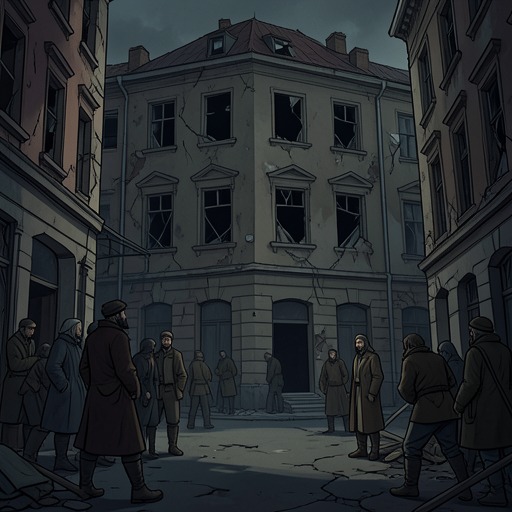
Bird BoxRiverbridge is both a place on a newspaper page and the physical setting of Malorie’s refuge from the growing catastrophe. The advertisement directs her toward a house where strangers have gathered, but the community’s survival depends on living with covered windows, moving blindfolded, and treating the nearby river as both a resource and a possible escape route. Its geography gives shelter a shape—and makes that shelter a source of risk.
Finding the refuge
The first indication that Riverbridge might offer safety appears in a classified advertisement on the back of a newspaper. A home there is opening its doors to strangers, describing itself as a safe house and a sanctuary while reports of incidents continue to mount. As the surrounding neighborhood grows silent and residents conceal their faces, the small notice provides Malorie with a concrete destination.
After Shannon dies, Malorie searches a stack of newspapers beneath the kitchen sink until she finds the advertisement again. Riverbridge is twenty minutes away, and she must take herself and her unborn child there. The discovery does not ease her fear; it gives her a direction in which to act. Later, she drives through the area for the first time since a New Year’s Eve party several years earlier, now alone and grieving. She travels slowly, searching for street signs and other cars, and reaches 273 Shillingham Lane without needing to consult her map: the address has occupied her thoughts throughout the drive.
The neighborhood offers no obvious sign of order or welcome. It is an ordinary suburb of similar-looking houses, overgrown lawns, shuttered windows, and a nearly empty street. A few parked cars identify the house she is seeking. Malorie stops with her eyes closed, retaining its faint image in her mind. The familiar residential landscape has become legible through concealment and sound rather than ordinary sight.
The house and its survival conditions
The safe house is not owned by the people living in it; Tom explains that its owner has died. The surrounding systems that once connected a household to the wider world have largely failed. There is no internet, newspapers no longer arrive, and the residents’ cell phones stopped working weeks earlier. Tom believes the people responsible for the cell towers may have stopped working or died. A landline still functions, however, along with the lights.
The source of that remaining electricity is local hydroelectric power. Tom believes the plant may continue producing power if its gates have been left in the right position, though he cannot guarantee how long the arrangement will last. He describes the river as the force powering the house and links the community’s prospects to its continued flow. The house thus survives not through a return to normality, but through a narrow dependence on infrastructure whose condition the residents cannot fully know.
Other essential systems have already failed. Running water stopped soon after Tom arrived, so the residents draw water from a well behind the house and use buckets. For sanitation, they take turns carrying waste to latrines dug as ditches in the woods. These tasks must be done blindfolded, turning everyday maintenance into a repeated operation under severe constraints. The arrangement provides a way to keep living in Riverbridge, but not the privacy, ease, or certainty associated with a functioning home.
Enclosure, well, and river
The house’s interior is organized around the danger of exposure. During Malorie’s approach, Shannon covers a window with a blanket and calls her inside, directing her to close the door. The residents maintain coverings over the windows, while the rules of daily life require them to avoid seeing what may be outside. The home offers protection precisely by restricting what its occupants can see and how they move.
Its rooms do not offer equal security. Tom points out that the cellar door is old and delicate, despite its lock; the attic door has a much stronger bolt. If something entered the house, he considers the attic the better place to secure themselves. The distinction makes the building’s ordinary features consequential: a door’s construction can determine whether a room is usable as refuge when the household’s outer defenses fail.
The well presents a different danger. Felix goes toward it with one of the housemates’ six buckets, a rope tied around his waist and anchored to a steel stake outside the back door. He is blindfolded, and pieces of old picture frames mark the path so that he can tell when he veers to either side. Even the bucket matters: he chooses a heavier wooden one with a black iron handle because, he says, it keeps him grounded. The scene shows a survival system built from improvised materials, tactile landmarks, and practiced movement rather than sight.
At the well, a sound unsettles Felix. He checks the cobblestone rim with his fingers, considering whether someone—or something—could fit inside, then turns the crank to raise the bucket. When he returns to the house in alarm, the household reacts collectively: the back door is shut, people call out at once, and Tom tells everyone to close their eyes. The episode makes clear that the well is not simply a source of water. It is an exposed point between the protected interior and the unknowable space outside, and a disturbance there can put the whole household on alert.
The river, about eighty yards behind the well, connects the house to both power and possible departure. Tom says the residents can hear it from the well, though there is no running water in the house. Years later, when Rick gives Malorie directions for reaching a refuge, he tells her to take the river and estimates that the journey will be at least twenty miles. He warns that it is dangerous and explains that the river will split, but maintains that the destination he is directing her toward is better. Riverbridge’s waterway is therefore not an uncomplicated route to safety: it is a hazardous passage that nevertheless offers a way out.
A precarious community
Life in the house depends on collective work and limited stores. Felix says that the group obtained canned goods during a supply run before the first incident was reported in the Upper Peninsula. They still have food intended to last about three months, though Don points out that the supply has diminished. Malorie wonders whether Don means that her arrival has increased the number of mouths to feed. Refuge is shared, but its resources have limits that are immediately apparent.
Water makes those limits more urgent. After Felix’s alarming return, the two buckets he filled remain untouched on the kitchen counter. Twenty-four hours pass, and the housemates become thirsty; they lick their lips and face the possibility of going without water for longer. Tom argues that they cannot stop trying to obtain it, particularly with Malorie’s pregnancy in view. The dispute exposes the cost of caution: avoiding a possible danger at the well also means withholding the resource the household needs to continue.
When Malorie first arrives, the housemates’ routine and stores offer a measure of welcome, not a promise of security. The survivors share space, work, food, and risk, while the systems supporting them remain partial: the landline and lights still work, but water must be hauled and sanitation managed outside. Riverbridge’s refuge is therefore sustained by cooperation and improvisation, rather than by the survival of ordinary domestic life.
From refuge to route
Riverbridge’s significance changes with the survivors’ circumstances. At first, the newspaper advertisement frames it as a destination: a place to reach after Malorie has lost Shannon and needs protection for herself and her child. Once she is inside, its geography governs daily decisions. The attic may be safer than the cellar, the well is necessary but uncertain, and the river lies close enough to provide power and a potential path onward.
That geography has a lasting cost. Malorie later remembers that years of survival have included close calls while moving through the house and carrying water back from the well; now, an injury to her shoulder makes her long for medical help, even as she fears what a stop would mean for the children. Riverbridge’s routines have kept the family alive, but they have also trained Malorie to measure movement, danger, and need against the constraints of a world without reliable care.
The location is ultimately defined by this contradiction. Its house can shelter strangers, and its river can sustain power and lead toward another refuge, but neither the building nor the landscape removes the danger outside. Riverbridge becomes a fragile interval between arrival and departure: a home made survivable by closed windows, guarded thresholds, shared labor, and a route whose promise is inseparable from its risk.